
Solar & battery
Solar Panels & Battery Storage
Generate your own electricity and store more of it with a battery, with a survey showing what's realistic.
- Realistic, property-specific advice
- Independent service
- No obligation
Prefer to talk? 0121 838 3030
- Daylight not direct sun — cloud reduces output rather than stopping it
- Most properties are workable — the question is how well
- Battery stores what you do not use — it generates nothing
- Export tariff larger suppliers must offer one under the Smart Export Guarantee
Explore this topic
The short version
How solar panels work
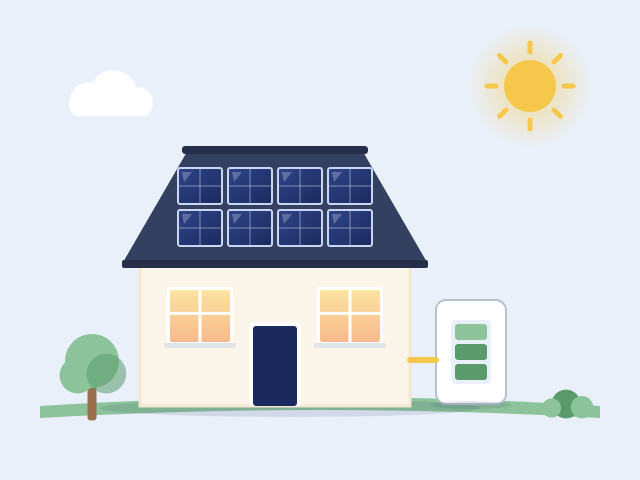
Daylight on the roof becomes electricity in the house.
- Panels turn daylight into electricity; an inverter makes it usable
- Powers whatever is running in the house at that moment
- Unused electricity is exported and can earn an export tariff
- The grid tops up anything extra — nothing switches over
- Using it as it is generated is usually worth more than exporting
- Generation is concentrated heavily in the summer
How it works, in full Show less
Daylight on the roof becomes electricity in the house. Everything else is detail about how much, and when.
A solar photovoltaic panel turns daylight into direct-current electricity. An inverter converts that into the alternating current your house runs on, and it is connected into your consumer unit so it feeds the sockets, lights and appliances that are drawing power at that moment.
Anything you generate and do not use goes back out to the grid rather than being wasted, and suppliers above a certain size are required to offer a tariff that pays for it under the Smart Export Guarantee. Anything you need beyond what the panels are producing comes from the grid exactly as it does now. Nothing switches over; the two simply add together.
That is the whole reason self-consumption matters more than headline generation. A unit you use as it is generated replaces a unit you would have bought. A unit you export is worth whatever your export tariff pays, which is usually rather less. Households that can move washing, dishwashing or car charging into daylight hours get more out of the same array than households that cannot.
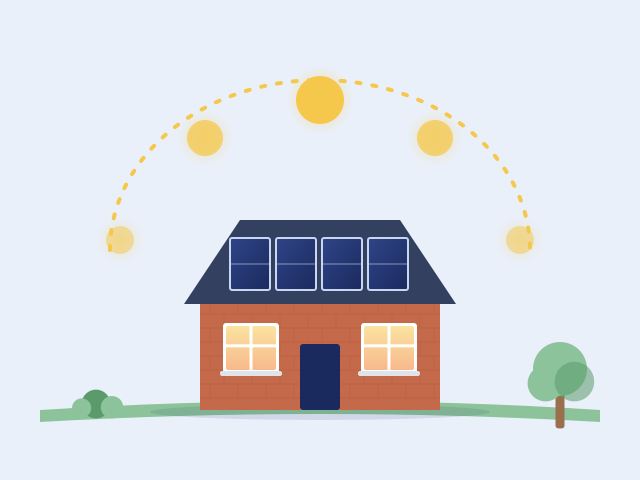
Panels respond to daylight rather than to direct sunshine, so an overcast day reduces output rather than stopping it. Across a British year, generation is concentrated heavily in the summer — which is worth knowing before pairing solar with anything that uses most of its electricity in January.
Before anything else
Is my home suitable?
Six things decide it. Most properties are workable; the question is how well.
-
Roof direction
South-facing generates most. East and west still work; north alone rarely does.
-
Shading
Chimneys, dormers, roofs or trees shading the array reduce output.
-
Roof condition and age
Panels stay up for decades — deal with a roof needing recovering first.
-
Space and roof structure
Usable area sets the panel count; the structure has to carry them.
-
Your electricity use
Worth most when you use power as it is generated, in daylight.
-
The consumer unit and connection
Must be suitable; the network operator is notified.
Suitability, in full Show less
Six things decide it, and a surveyor will look at all of them. Most properties are workable; the question is usually how well, not whether.
Roof direction
A south-facing pitch generates the most over a year. East and west-facing roofs still work and shift more of the generation towards morning and evening, which can suit a household that is out mid-day. A north-facing pitch alone is rarely worth it.
Shading
A chimney, a dormer, a neighbouring roof or a mature tree that shades part of the array reduces output — and on some system designs it reduces more than the shaded area alone. This is one of the first things a surveyor looks at.
Roof condition and age
Panels are expected to stay up for decades, so a roof that will need recovering soon is worth dealing with first. Re-roofing under an existing array means paying to remove and refit it.
Space and roof structure
The usable area decides how many panels fit, and the roof structure has to carry them. Older or altered roofs sometimes need a structural check before an installation is signed off.
Your electricity use
Solar is worth most when you use the electricity as it is generated. A household at home during the day, or one that can shift washing, dishwashing and car charging into daylight hours, gets more from the same array than one that is out until seven.
The consumer unit and connection
The existing consumer unit and earthing arrangement have to be suitable, and the installation has to be notified to the network operator. Larger systems need permission before they are connected rather than after.
The other half of the decision
Solar panels and battery storage
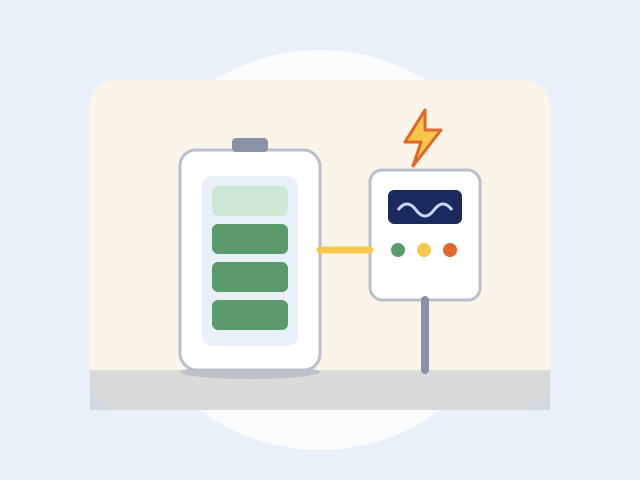
A separate purchase that solves a specific problem.
- Stores unused solar electricity for the evening
- Does not generate anything or make panels more efficient
- Worth most if you would otherwise export a lot
- Can also charge from the grid on a time-of-use tariff
- Not a power cut solution by default. Backup must be designed in.
Battery storage, in full Show less
A battery is a separate purchase that solves a specific problem. It is worth understanding which problem before pricing one.
A home battery stores electricity your panels have generated and you have not used, so that you can use it in the evening instead of exporting it during the afternoon. It does not generate anything, it does not make the panels more efficient, and it does not change how much the array produces.
Whether it earns its cost depends on the gap between what you pay for a unit of electricity and what your export tariff pays you for one — and on how much of your generation you would otherwise be exporting. A household that is out all day exports a lot and stands to gain more from storage than one that is already using most of what it makes.
Batteries can also be charged from the grid on a time-of-use tariff, independently of the solar array. That is a different proposition with a different sum behind it, and it is worth being clear which of the two any quotation is actually based on.
Our guide to home battery storage covers the 0% VAT rate, the schemes that can include a battery, and how export payments work.
A battery is not a power cut solution by default
Most domestic battery installations shut down in a power cut along with everything else, for the safety of anyone working on the network. Backup during an outage is a specific feature that has to be designed and wired in. If that matters to you, ask about it explicitly rather than assuming a battery provides it.
What moves the price
What affects installation cost?
We do not publish a price — these six things decide where your property lands.
-
The number of panels
The biggest factor — set by usable roof area and your electricity use.
-
Roof type and access
Mounting varies by roof; height and access drive labour.
-
Inverter arrangement
A string inverter is usual. Optimisers cost more; suit shade or mixed directions.
-
Battery storage
A separate decision with its own cost.
-
Electrical work
An older consumer unit, long cable runs or earthing upgrades add to the job.
-
Scaffolding
Nearly every pitched roof needs it — a real line on the quote.
What to ask for in a quotation
- Panel count and rating
- Inverter type
- Whether scaffolding is included
- What the electrical work covers
Cost factors, in full Show less
We do not publish a price for a solar installation, because the honest answer is a range wide enough to be useless. These are the things that decide where in that range a particular property lands.
The number of panels
The single biggest factor. System size is driven by the usable roof area and by how much electricity the household actually uses.
Roof type and access
Slate, tile, flat and metal roofs each need different mounting. Height, scaffolding requirements and access affect the labour more than the hardware does.
Inverter arrangement
A single string inverter is the usual choice. Optimisers or micro-inverters cost more and earn their place on a roof with shading or with panels facing more than one direction.
Battery storage
A battery is a separate decision with its own cost. It stores what you generate and do not use, rather than generating anything itself.
Electrical work
An older consumer unit, a long cable run to the inverter position, or upgrading earthing all add to the job.
Scaffolding
Nearly every pitched-roof installation needs it, and it is a real line on the quotation rather than an extra.
Getting a quotation
A quotation produced without someone looking at the roof is not a quotation. Ask for the panel count and rating, the inverter type, whether scaffolding is included, and what the electrical work covers — the difference between two prices is usually in those lines rather than in the panels.
Is there a grant for solar panels?
Not for every household — most solar installations are self-funded.
- Warm Homes: Local Grant: may cover panels and batteries for eligible lower-income households in England
- Grants overview: compares every scheme
Solar grants, in full Show less
Not for every household — most solar installations are self-funded. Eligible lower-income households in England may get solar panels and batteries through the Warm Homes: Local Grant. The grants overview compares every scheme, and our guide to solar panel grants in 2026 sets out what is actually available.
What happens
The installation process
Five stages, from the first look at the roof to the paperwork afterwards.
-
Step 1: Survey
Roof, pitch, direction, shading and consumer unit checked.
-
Step 2: Design
Panels, inverter, cable routes — and whether a battery is included.
-
Step 3: Permissions
Permitted development checked; network operator notified.
-
Step 4: Install
Scaffolding, panels, inverter and connection — a small number of days.
-
Step 5: Handover
Tested and certified. Keep the certificates for an export tariff.
Each stage, in full Show less
1. Survey
Someone looks at the roof, the pitch, the direction, the shading and the consumer unit, and measures the usable area. A quotation produced without this is a guess.
2. System design
Panel count and layout, inverter type and position, cable routes, and whether a battery is part of it. This is where shading and roof direction turn into a specific design.
3. Permissions and notification
Most domestic installations are permitted development, but not all — listed buildings and conservation areas are the common exceptions. The network operator is notified, and larger systems need their agreement before connection rather than after.
4. Installation
Scaffolding, mounting rails, panels, inverter and the electrical connection. Most domestic installations are a small number of days on site.
5. Commissioning and handover
The system is tested, the paperwork is issued, and you are shown how to read what it is doing. Keep the certificates — you need them to arrange an export tariff.
Ask your installer about certification
Certification under a recognised scheme matters for solar in a practical way: most suppliers require it before they will put you on an export tariff under the Smart Export Guarantee — for solar that normally means an MCS-certified installation. Ask any installer for their certification number and check it on the scheme's own register rather than taking a logo on a website as evidence — including ours.
Solar FAQs
Do solar panels work on a cloudy day?
Yes, but they generate less. Panels respond to daylight rather than to direct sun, so output falls on an overcast day rather than stopping. Generation across a British year is concentrated heavily in the summer months.
Do I need planning permission?
Most domestic roof installations are permitted development in England and Wales, subject to conditions on how far the panels project and where they sit. Listed buildings, conservation areas and some flats are the usual exceptions. Check with your local planning authority before committing.
What does a battery actually do?
It stores electricity you have generated but not used, so you can use it later instead of exporting it. It does not generate anything and it does not make the panels more efficient. Whether it is worth adding depends on how much of your generation you would otherwise export and on what you are paid for that export.
Can I get paid for the electricity I export?
Electricity suppliers above a certain size are required to offer an export tariff under the Smart Export Guarantee. Rates differ between suppliers and you apply to a supplier directly. Most require the installation to have been carried out under a recognised certification scheme, which is one reason to confirm your installer holds one.
Will solar panels work with a heat pump?
They are complementary rather than dependent on each other: a heat pump runs on electricity, and solar generates some of it. The two do not have to be installed together, and the seasons work against the pairing — a heat pump uses most electricity in winter, when a solar array generates least.
Is there a grant for solar panels?
Not for every household. The Boiler Upgrade Scheme does not fund solar panels or batteries. In England, the Warm Homes: Local Grant can include solar panels and batteries for eligible lower-income households, and ECO4 can include solar only alongside a heat pump or suitable electric heating. Most solar installations are self-funded.
How long do solar panels last?
Manufacturers generally warrant panel output over a period of decades, with a gradual decline in performance rather than a failure point. An inverter has a shorter working life than the panels and should be expected to need replacing at some stage during the system’s life.
Do the panels need maintenance?
Very little. British rainfall keeps most roof-mounted arrays reasonably clean. What is worth doing is checking occasionally that the system is still generating what it normally does at that time of year, because a fault otherwise goes unnoticed for months.
Thinking about solar for your home?
Tell us about the property and how you use electricity, and we will come back to you about what would realistically suit it.