
England, Wales and Scotland
31 December 2026 ECO4 closes to new work
Ends 31 December 2026
ECO4 Grant: Insulation and Heating Support
Energy suppliers fund insulation and heating for qualifying lower-income and vulnerable households, until the scheme closes.
- Free eligibility check
- Independent advice
- No obligation
Prefer to talk? 0121 838 3030
- 31 December 2026 Work must be completed before it closes
- England, Wales and Scotland Not Northern Ireland
- Energy suppliers Fund it; Ofgem administers it
- Not guaranteed Suppliers decide which projects they fund
Key facts
- Amount
- No set amount. Energy suppliers fund the work they agree to, such as insulation or heating
- Who qualifies
- Households receiving a qualifying means-tested benefit, or lower-income households a council declares eligible (Flex, for example below £31,000). Homes rated D to G; E to G if privately rented.
- Where
- England, Wales and Scotland
- Deadline
- ECO4 ends on 31 December 2026. Work has to be completed by then.
- How to apply
- There is no government application. The work is arranged through an energy supplier’s installer, or through your council for Flex. Ofgem’s ECO guidance for households (opens in a new tab)

In short
What ECO4 is
A legal obligation on larger energy suppliers, administered by Ofgem.
- Insulation and heating for lower-income and vulnerable households
- Funded by larger energy suppliers; Ofgem administers it
- You do not apply to the government
- England, Wales and Scotland — not Northern Ireland
- Eligibility does not guarantee funding
What ECO4 is, in full Show less
A legal obligation on larger energy suppliers to fund energy-efficiency and heating improvements for lower-income and vulnerable households, administered by Ofgem.
Energy suppliers fund insulation and heating improvements for qualifying lower-income and vulnerable households in England, Wales and Scotland, until the scheme closes at the end of 2026. Eligibility does not guarantee funding: energy suppliers decide which projects they fund.
Where it applies
England, Wales and Scotland. Not Northern Ireland.
Who pays
Larger energy suppliers fund it, and Ofgem administers it. You do not apply to the government.
When it ends
31 December 2026. Work must be completed before 1 January 2027, and no replacement supplier obligation is planned.
Timing matters
ECO4 is currently scheduled to end on 31 December 2026, unless the rules change.
- Survey, assessment and installation must all be completed first
- Work must be finished before 1 January 2027
- No replacement supplier obligation is planned
- If ECO4 may be relevant, check sooner rather than later
Timing, in full Show less
ECO4 is currently scheduled to end on 31 December 2026, unless the rules change. A survey, assessment and installation all have to be completed before then, so if ECO4 is relevant to your home it is worth checking sooner rather than later. If it cannot be completed in time, the Warm Homes: Local Grant may be an alternative in England.
Who may qualify
Usually through benefits or your council’s Flex route. EPC rating and tenure matter too.
Household routes
-
Means-tested benefits
Someone in the household gets a qualifying benefit, such as Universal Credit or Pension Credit.
-

ECO4 Flex (through your council)
A participating council declares a private household eligible — for example on income below £31,000.
Homeowners, tenants and landlords
-
Homeowners
Homes rated EPC D to G (E to G on some Flex routes).
-
Private tenants and landlords
Rented homes rated E to G, with the landlord’s permission.
-
Social housing
Homes rated D to G let below market rent.
The improvement has to be significant. The work has to make a real difference: homes rated D or E must reach at least band C, and homes rated F or G must reach at least band D.
Who may qualify, in full Show less
Households usually qualify through benefits or through their council’s Flex route. The home’s EPC rating and tenure also matter.
Household routes
Means-tested benefits
Someone in the household receives a qualifying benefit, such as Universal Credit, Pension Credit, Housing Benefit, income-based Jobseeker’s Allowance, income-related ESA, Income Support or, subject to income limits, Child Benefit.
ECO4 Flex (through your council)
A participating council can declare a private household eligible — for example on household income below £31,000, or on a combination of other factors such as health conditions. This route is not available for social housing.
Homeowners, tenants and landlords
Homeowners
Homes rated EPC D to G can be eligible (E to G on some Flex routes).
Private tenants and landlords
Rented homes rated E to G can be eligible, with the landlord’s permission. The work normally has to include a measure such as solid wall insulation, first-time central heating or renewable heating.
Social housing
Homes rated D to G let below market rent can be eligible, with narrower rules for D-rated homes.
Looking for insulation or a boiler in particular? Our guides to insulation grants and the free boiler grant compare ECO4 with the other schemes.

What ECO4 can fund
Measures depend on the survey and on what the supplier agrees to fund.
- Loft, cavity, solid wall and underfloor insulation
- First-time central heating for homes that have never had it
- Replacing broken or inefficient heating, and heating controls
- Heat pumps and other renewable heating
- Solar panels, but only alongside a heat pump or suitable electric heating
Heating under ECO4
ECO4 is not a general new-boiler grant.
-
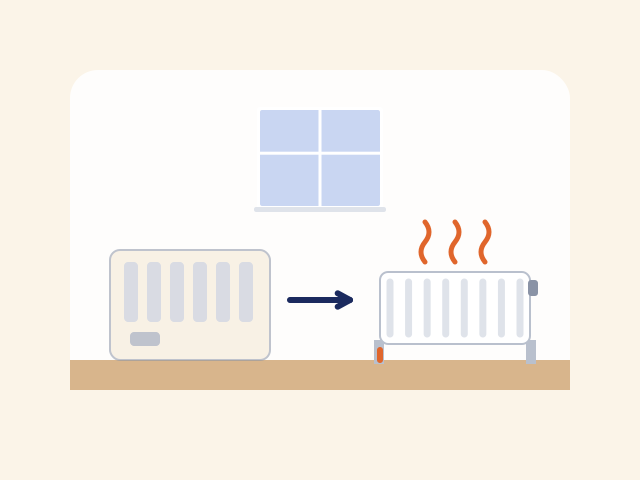
First-time central heating
Homes that have never had central heating can be a strong fit, usually alongside insulation.
-
Heating upgrades
Broken or very inefficient heating can be replaced. A straight boiler swap alone is unlikely to qualify.
-

ECO4 vs the Boiler Upgrade Scheme
ECO4 targets lower-income households. The Boiler Upgrade Scheme has no income test.
Heating under ECO4, in full Show less
First-time central heating
Homes that have never had a central heating system — for example those heated by room heaters or old electric heating — can be a strong fit, usually alongside insulation.
Heating upgrades
Broken or very inefficient heating can be replaced where the overall package improves the home’s rating enough. ECO4 is not a general new-boiler grant, and a straight boiler swap on its own is unlikely to qualify. For self-funded replacements, see our new boiler installation page.
How ECO4 differs from the Boiler Upgrade Scheme
ECO4 is aimed at lower-income and vulnerable households and funded by energy suppliers. The Boiler Upgrade Scheme has no income test and gives a fixed grant towards a heat pump for property owners. Our guide to ECO4 vs the Boiler Upgrade Scheme compares them side by side.
ECO4 is delivered by suppliers, not government
You do not apply to the government. Energy suppliers decide which projects they fund, and the work is arranged through their installers — so being eligible does not mean funding is guaranteed.
Be cautious of anyone who guarantees ECO4 funding on the doorstep or asks for an upfront fee to secure it.

Check whether ECO4 could apply
Tell us about your household and home.
- Whether ECO4 looks worth pursuing before it closes
- Which other scheme may fit if it does not
- Free to ask. No obligation.
Frequently asked questions
When does ECO4 end?
ECO4 is scheduled to end on 31 December 2026. Work has to be completed before 1 January 2027 to count, so a survey, design and installation all need to fit before then. The government has said there will be no successor energy supplier obligation; low-income support is moving to grant schemes instead.
Is ECO4 a free boiler scheme?
Not as such. ECO4 can fund heating upgrades — including replacing broken or inefficient heating and first-time central heating — for qualifying households, but the work has to improve the home’s energy rating by a set amount, usually alongside insulation. Suppliers decide which projects to fund, so nothing is guaranteed.
Can I get ECO4 if I rent my home?
Private tenants can be eligible where the home is rated EPC E, F or G and the landlord gives permission. Social housing tenants can benefit where their landlord takes part.
Can landlords apply for ECO4?
Landlords do not qualify in their own right: a privately rented home qualifies through the tenant household’s eligibility, with the landlord’s permission. The home must be rated E to G, and the work normally has to include a measure such as solid wall insulation or renewable heating.
Does ECO4 pay for solar panels?
Only in specific cases: solar panels can count when the home is, or will be, heated by a heat pump or suitable electric heating. ECO4 is not a general solar grant.
What is ECO4 Flex?
Flex lets a participating local council declare a private household eligible when it does not receive a qualifying benefit — for example because household income is below £31,000, or because of a combination of factors such as a health condition made worse by a cold home.
Is the Great British Insulation Scheme still open?
No. The Great British Insulation Scheme ended on 31 March 2026 and was not extended.
Not sure whether ECO4 or another scheme fits?
Tell us about your home and we will help you understand the most relevant next step.
or call 0121 838 3030