
What “all-electric” means
An all-electric home has no gas, oil or LPG appliance left in it. In an existing house that usually means four changes:
- Heating and hot water from a heat pump, with a hot water cylinder in place of a combi boiler.
- An electric hob, usually induction, in place of a gas one. A gas fire goes too, or is replaced by an electric one.
- The gas meter removed and the account closed, which ends the gas standing charge.
- Optionally, your own generation: solar panels on the roof, and a battery to hold daytime electricity for the evening.
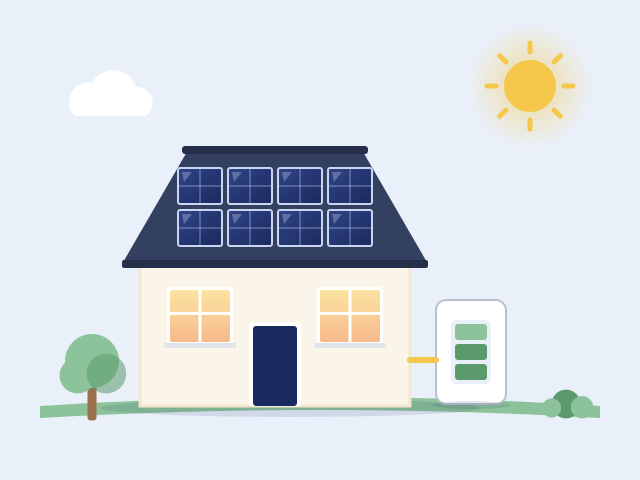
Two ideas get mixed up here, and this guide keeps them apart. The first is going all-electric, which is a set of installations and a decision about the gas supply. The second is the zero bill, which is a claim about what those installations will do to your costs over a year. The first is straightforward. The second needs a sum.
What pays for what
Air source heat pump
£7,500
The Boiler Upgrade Scheme grant for an eligible air-to-water heat pump replacing gas, oil, LPG or electric heating. The only part of an all-electric home a grant pays for, for most households.
Enhanced off-gas value
£9,000
Instead of the standard grant, for homes off the mains gas grid replacing oil or LPG heating.
For applications properly made by
The grant is one per property and covers heat pumps only. Our step-by-step guide to getting an air source heat pump through the Boiler Upgrade Scheme covers the application. Everything else is paid for separately.
| Grant | VAT | Other help | |
|---|---|---|---|
| Air source heat pump | £7,500 | 0% VAT on installation until 31 March 2027 | Warm Homes Plan loans, once lenders are named |
| Solar panels | None for most households | 0% VAT on installation until 31 March 2027 | Export payments; Warm Homes Plan loans of up to £15,000, once lenders are named |
| Home battery | None for most households | 0% VAT on installation until 31 March 2027 | Warm Homes Plan loans of up to £15,000, once lenders are named |
| Induction hob and electrical work | None | Standard rate | — |
| Gas meter removal | None | — | Some suppliers do it free; ask |
Installed solar panels, batteries and heat pumps in homes have 0% VAT until 31 March 2027, after which the rate is due to return to 5%. The Warm Homes Plan sets aside money for low and zero-interest loans for solar, batteries and heat pumps, with caps of £15,000 for solar and £15,000 for a battery in the scheme rules, but GOV.UK had not named a participating lender when we checked. Our Warm Homes Plan loans page tracks that.
Some lower-income households can get solar panels funded. Our solar panel grants guide sets out who qualifies, nation by nation.
Why a heat pump and solar suit each other, and why they do not
Within a day, the two fit well. Solar panels generate in daylight, and a heat pump runs through the day rather than overnight, so on a bright day the panels can cover the heat pump’s hot water run and some of its heating.
Solar panels Generate in daylight
Heat pump Runs through the day
Across a year, they pull apart. The panels make most of their electricity between April and September. The heat pump uses most of its electricity between November and February, on short, dull days when the panels produce least. That is the single fact behind the zero bill question.
Solar panels Electricity generated
Heat pump Electricity used
A battery helps with the first picture, not the second. It moves daytime solar into the evening, which is useful every month there is a surplus. It cannot carry July’s sunshine into January, because the surplus a home battery can hold is measured in hours, not seasons.
The zero bill sum
A “zero bill” over a year means the money coming in from exports matches the money going out for imports and standing charges. It does not mean the home buys no electricity. In winter, it will.
The sum, in words
Annual bill = (electricity imported × import rate) + (365 × daily standing charge) − (electricity exported × export rate).
The bill is zero when the last term is as large as the first two together. Every design decision below moves one of those six numbers.
What pushes the bill down
- Removing the gas supply. The gas unit rate and the gas standing charge both disappear.
- A heat pump designed for low water temperatures. Several units of heat for each unit of electricity, and more of them when the radiators let the water run cool. Our heat pump running costs guide shows the sum.
- Solar sized to the house. Electricity you make and use at home is electricity you do not buy.
- A battery and a time-of-use tariff. The battery shifts solar to the evening and can fill up overnight at a cheap rate, so the heat pump and the hob run more often on your own or cheaper power.
- Export payments. Under the Smart Export Guarantee, larger suppliers must pay for exported electricity, and each sets its own rate and terms, so compare them.
What keeps it above zero
- The seasons. A winter shortfall bought at the import rate has to be paid for by a summer surplus sold at the export rate. Where the export rate is lower, as it usually is, a unit exported in June does not cancel a unit imported in January one for one.
- The standing charge. Under the October to December 2026 price cap, the average electricity standing charge is 54.83p a day. That is about £200 a year before a single unit is bought, and it has to be covered by exports too.
- The roof. A mid-terrace roof, a north-facing slope, a chimney, a dormer or a tall tree next door all cut what the panels can make.
- Heat loss. An uninsulated home needs more heat, a larger heat pump and more electricity in exactly the months the panels produce least.
- How you live. A home kept at 21°C with a family of five in it uses more than one kept at 19°C by two people.
We do not publish savings or generation figures, because they belong to one roof and one household. An MCS-certified installer should give you an estimate for your own home in writing, for both the heat pump and the panels.
What a “zero bills” offer actually is
Some energy suppliers and housebuilders market homes with a guaranteed zero energy bill for a fixed number of years. That guarantee is a commercial promise by the supplier, attached to a specific set of equipment it has specified, a home that meets its standard and its own tariff. It is not a property of heat pumps and solar panels in general, and most such homes are new builds. If an offer like that is made for your existing home, ask for the equipment list, the fabric standard, the tariff terms and what happens after the guarantee period, all in writing.
Getting as close to zero as your home allows

-
Step 1: Fabric first
Loft, wall and floor insulation and draught-proofing. Every unit of heat the house keeps is a unit the heat pump never has to make. Our insulation grants page lists the schemes.
-
Step 2: Heat-loss survey and low-temperature design
Room by room, with the heat pump sized to the home and the radiators sized for cool water. This is also where the grant is assessed.
-
Step 3: Roof survey, sized with the heat pump in mind
Roof area, direction and shade, and an estimate of annual generation and how much of it the home can use. Ask for the heat pump’s expected electricity use to be included.
-
Step 4: Decide on a battery and a tariff
Compare the battery’s price with what it would save by shifting solar and cheap overnight electricity. The tariff decides much of the answer.
-
Step 5: Install, with the electrics done once
A heat pump, panels and a battery all need the electrical supply checked and the network operator told. Doing them together avoids paying twice.
-
Step 6: Replace the hob and remove the gas meter
Once nothing uses gas, ask the supplier to remove the meter and close the account. Get the cost in writing first.
-
Step 7: Pick the import and export tariffs together
The peak rate, the cheap rate, the standing charge and the export rate all matter. Check that the export tariff accepts your set-up, especially with a battery.
-
Step 8: Run it well through the first winter
Weather compensation on, a steady room temperature, hot water heated when power is cheap or the sun is out, and a look at the figures after a year.
The order, if the budget forces a choice
Do the heat pump first. That is where the grant is, and it is the gas bill that goes. But have the roof surveyed on the same visit, so the panels are sized against the heat pump’s expected electricity use rather than against last year’s bills, which no longer apply.
Leaving the gas network
Removing the gas supply is what turns a home with a heat pump into an all-electric home, and it is the step people least expect to be awkward. Two organisations are involved:
- Your gas supplier removes the meter and closes the account. Some do this free, some charge, so ask for the cost in writing.
- The gas network operator owns the pipe to the house. It caps the supply, and may later disconnect it at the main.
Ofgem has found that the current process for households to exercise their choice to disconnect their gas supply is costly, that the rules are complex and that there is little clear guidance, and it is reviewing the framework. Until that changes, the safe approach is to get the meter removed, keep the paperwork, and not pay for the pipe to be dug out unless building work needs it.
Keep one thing in mind on cooking. If you keep a gas hob, the gas supply stays, and so does its standing charge. An induction hob is the usual answer, and it needs its own electrical circuit, which is one more reason to plan the electrics once.
Before you sign anything
- Both installers should be MCS-certified: the heat pump installer must be, for the grant, and the solar installer should be, for export tariffs. The MCS search lets you check that a business is certified for the technology you are having installed.
- Ask for the heat pump’s performance estimate and the solar system’s generation estimate, and for the share of that generation the home is expected to use itself.
- Ask what the estimate assumes for a cold winter, for the tariff and for who keeps the export income.
- Check the battery and export rules. If a battery also charges from the grid, a supplier does not have to pay for that export. Our home battery storage guide explains what to check.
- Confirm who tells the network operator about the heat pump, the panels and the battery.
- Be wary of a promise of free solar for any household, or a guaranteed zero bill, without the figures behind it in writing. Our guide to energy grant scams lists the warning signs.
Warm Home Support is an information and enquiry service, not an installer. If you want solar and a battery looked at alongside a heat pump, say so when you enquire. Any survey or quotation is carried out by a suitably qualified installer, and for a Boiler Upgrade Scheme heat pump that must be an MCS-certified installer.
Check your property
Pick the grant you want to check. Three quick checks, then our team calls you back. It is free, with no obligation.


